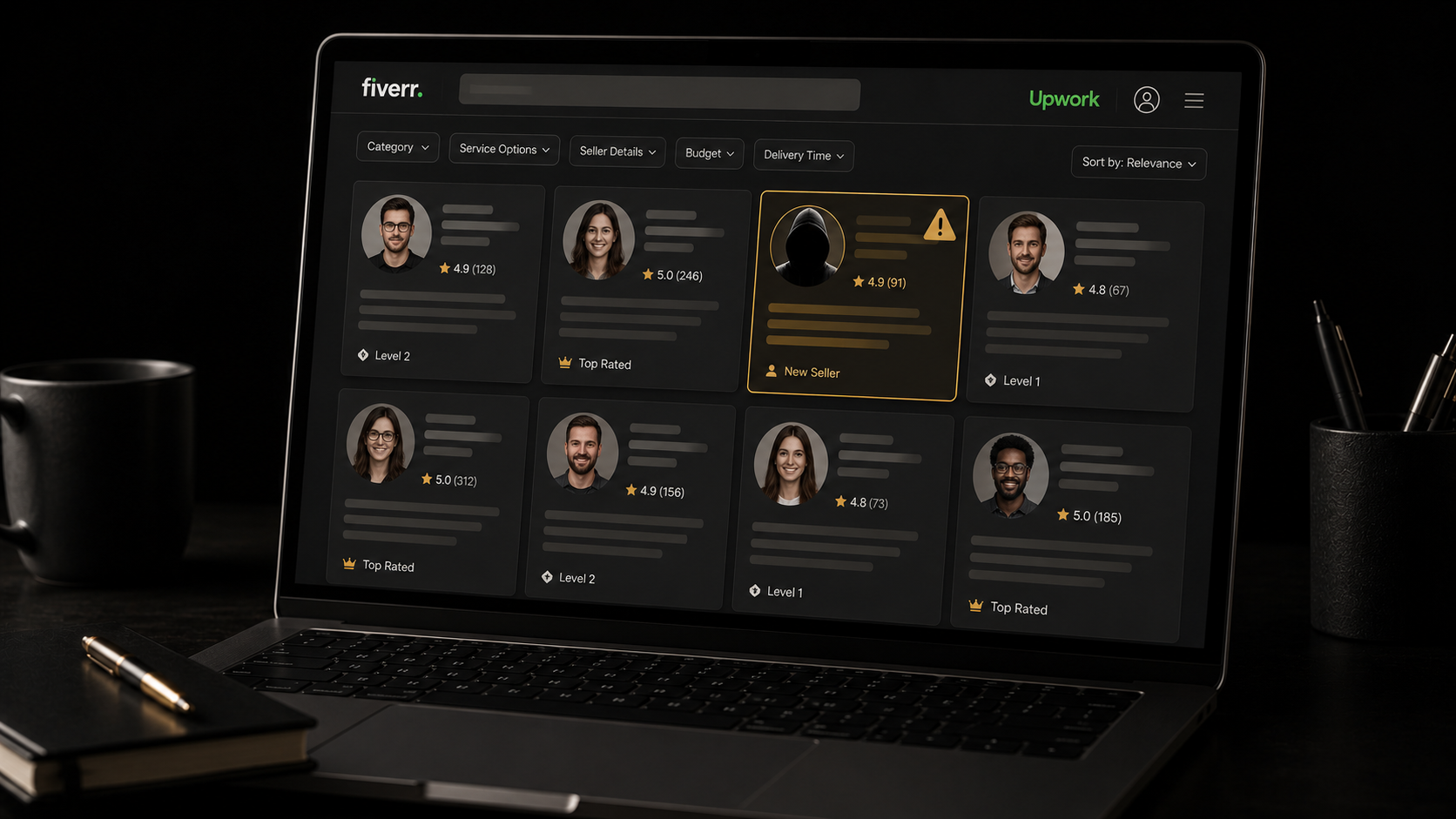
Millions of legitimate transactions happen on Fiverr and Upwork every year, including plenty of good copywriting work. This isn't a "avoid marketplaces entirely" article — that advice would be both impractical and a little dishonest, since I sell services on both platforms myself. It's a "know the specific ways this goes wrong" article, because the failure patterns are narrower and more predictable than most horror-story threads make them sound.
The Fake-Profile Problem
The most documented scam pattern: accounts built using someone else's real photo and credentials, luring buyers with rates well under market, then either delivering nothing or scope-creeping mid-project with demands for more money. One case documented by the Better Business Bureau involved a $2,000 project where the buyer paid $1,000 upfront, only to have the "freelancer" demand an additional $12,000 for a fraction of the promised work. These accounts rely on volume and speed — underpricing to get picked fast, before a buyer has time to look closely.
The Off-Platform Trap
Both Fiverr and Upwork build in buyer protections — payment escrow, dispute resolution, identity verification — that only apply while the transaction stays on the platform. The moment communication or payment moves to email, WhatsApp, or a bank transfer "to save on fees," every one of those protections disappears. This is the single most common way a marketplace interaction turns into an actual loss, and it's also the easiest one to avoid: if someone's asking to move off-platform before any work has started, that's the moment to slow down, not speed up.
"Too Good to Be True" Is a Research Signal
The instinct to grab the cheapest bid is understandable — it's also exactly what the fake-profile pattern is built to exploit. Before accepting a rate that looks unusually low, it's worth a quick cross-check against what copywriters actually charge in 2026. A bid sitting far below that range isn't a lucky find. It's either someone still learning, or someone who isn't who the profile claims.
Standard advice worth repeating because it holds up: research typical rates before you're evaluating bids, not after. It's much easier to spot an outlier when you already know what normal looks like.
What a Legitimate Profile Actually Looks Like
A few things that correlate with a real, established freelancer rather than a fresh or fake account: a review history that's built up gradually over time rather than a burst of five-star reviews in one week, samples that link to live, checkable work rather than screenshots only, responsiveness that's fast but not suspiciously instant on every message, and — the simplest check of all — a willingness to talk through their process before you commit to anything, on-platform, in writing.
A Note on Where I Fit Into This
I list services on both platforms, at the same public prices as this site, because plenty of buyers start their search there and there's nothing dishonest about meeting people where they're already looking. The standards don't change by platform: real reviews build up over time rather than appearing all at once, the scope and price are stated plainly before anything starts, and everything stays on-platform where the protections that exist actually apply. If a listing — mine or anyone else's — doesn't look like that, that's worth noticing.