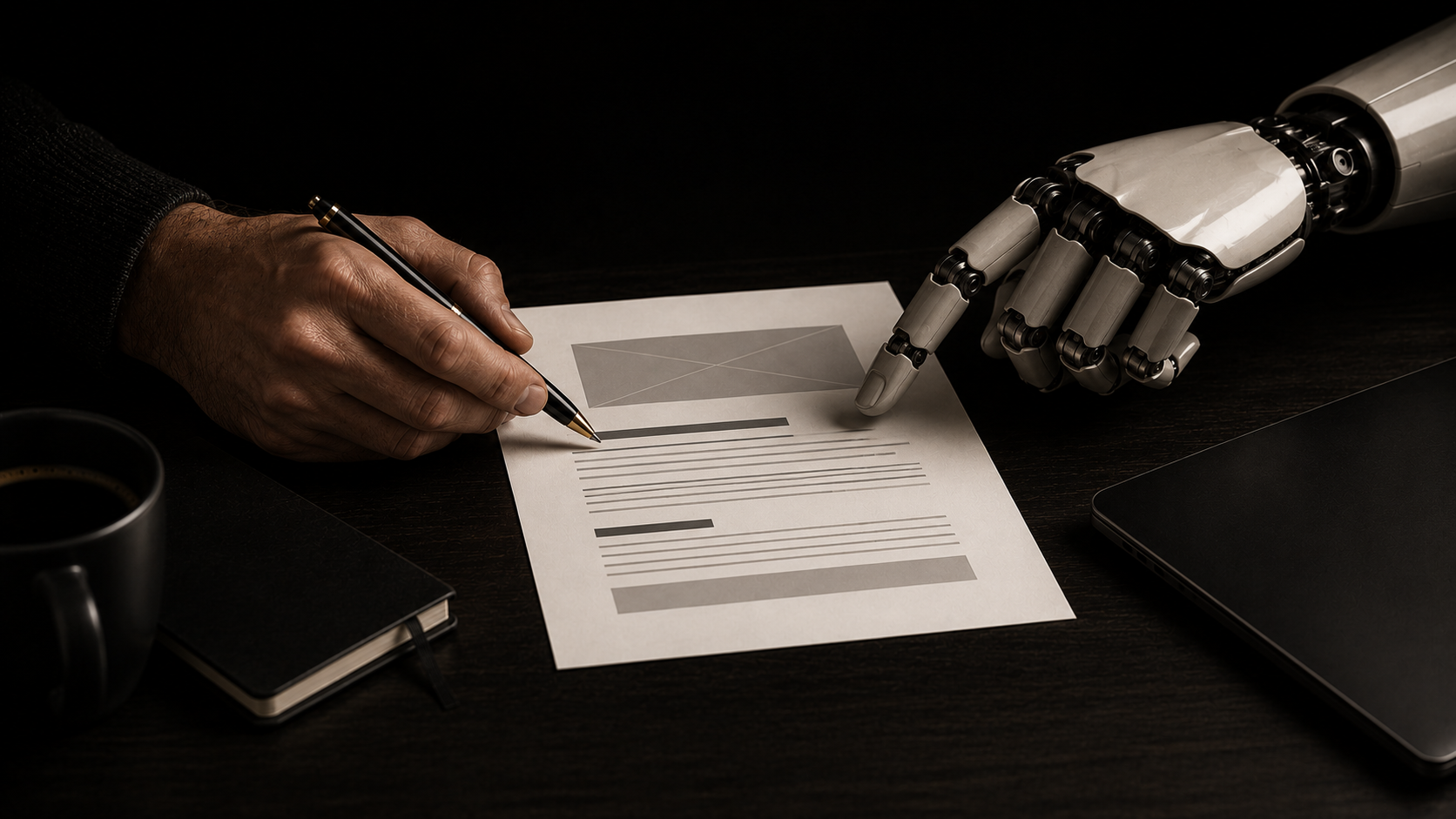
Fair question, and you should actually ask it before spending money either way: can you just get ChatGPT (or whatever's newest by the time you're reading this) to write the page and skip the whole hiring process?
Sometimes, yes. The honest answer isn't "never" — it's "depends what you're asking it to do," and most of the content telling you otherwise has a reason to oversimplify in one direction or the other.
What AI Is Actually Good At Now
Genuinely useful, no asterisk needed: first drafts to react against, variations on a headline you already like, organizing a pile of research into something scannable, and speed on formats where "good enough, fast" beats "perfect, slow" — routine product descriptions, internal notes, first-pass outlines. If you need volume on low-stakes copy, AI in 2026 does that job well, and pretending otherwise is its own kind of dishonesty.
Where It Still Falls Apart
The gap shows up on anything that depends on knowing something AI can't know from a prompt: what your specific customers actually said, in their actual words, about your actual product. AI can write confidently about a "pain point" — it can't tell you which pain point your buyers mention 40 times and which one they've never brought up once, because that requires reading real reviews, real support tickets, real call transcripts. It can produce a headline that sounds persuasive. It can't produce one built from a phrase a real customer used unprompted, because it has no access to that phrase unless a human hands it over.
That's the actual skill gap in 2026 — not "writing," which AI does adequately, but research, which it can't do without you.
"AI didn't kill copywriting. It killed low-grade informational SEO." A framing repeated across multiple 2026 industry analyses, and probably the single most useful sentence in this whole debate.
The Hybrid Reality Nobody's Marketing
The most effective copywriters working in 2026 aren't purists in either direction. They use AI extensively — for research organization, first-draft speed, testing variations — and they apply human judgment to the part that actually determines whether the copy sells: which insight matters most, which words to keep, which claim needs a source before it's trustworthy. The skill isn't "avoid AI" or "let AI do it." It's knowing exactly where the line sits and never letting it move without someone deciding on purpose.
Nobody's selling that nuance, because "AI will replace you" and "AI can never replace real writers" both make better headlines than "it's complicated and depends on the task."
A Simple Way to Decide
Ask yourself one question: does this piece of copy need to reflect something specific and true about my customers, or is it fine as competent, generic writing? A returns policy page, an internal FAQ, a routine product description — probably fine with heavy AI assistance and light editing. A landing page asking a stranger to spend real money, an email sequence meant to overcome a specific objection your buyers keep raising, a headline that needs to stop a skeptical reader mid-scroll — that's where the research-and-judgment gap actually costs you money if you skip it.
What This Actually Means for Your Decision
If what you need is volume on low-stakes copy, you probably don't need to hire anyone — a careful person with a good AI workflow and some editing discipline will do fine. If what you need is a page that has to convert a skeptical stranger into a paying customer, the thing you're actually buying from a human copywriter isn't the sentences. It's the research nobody else did, and the judgment about what to do with it.