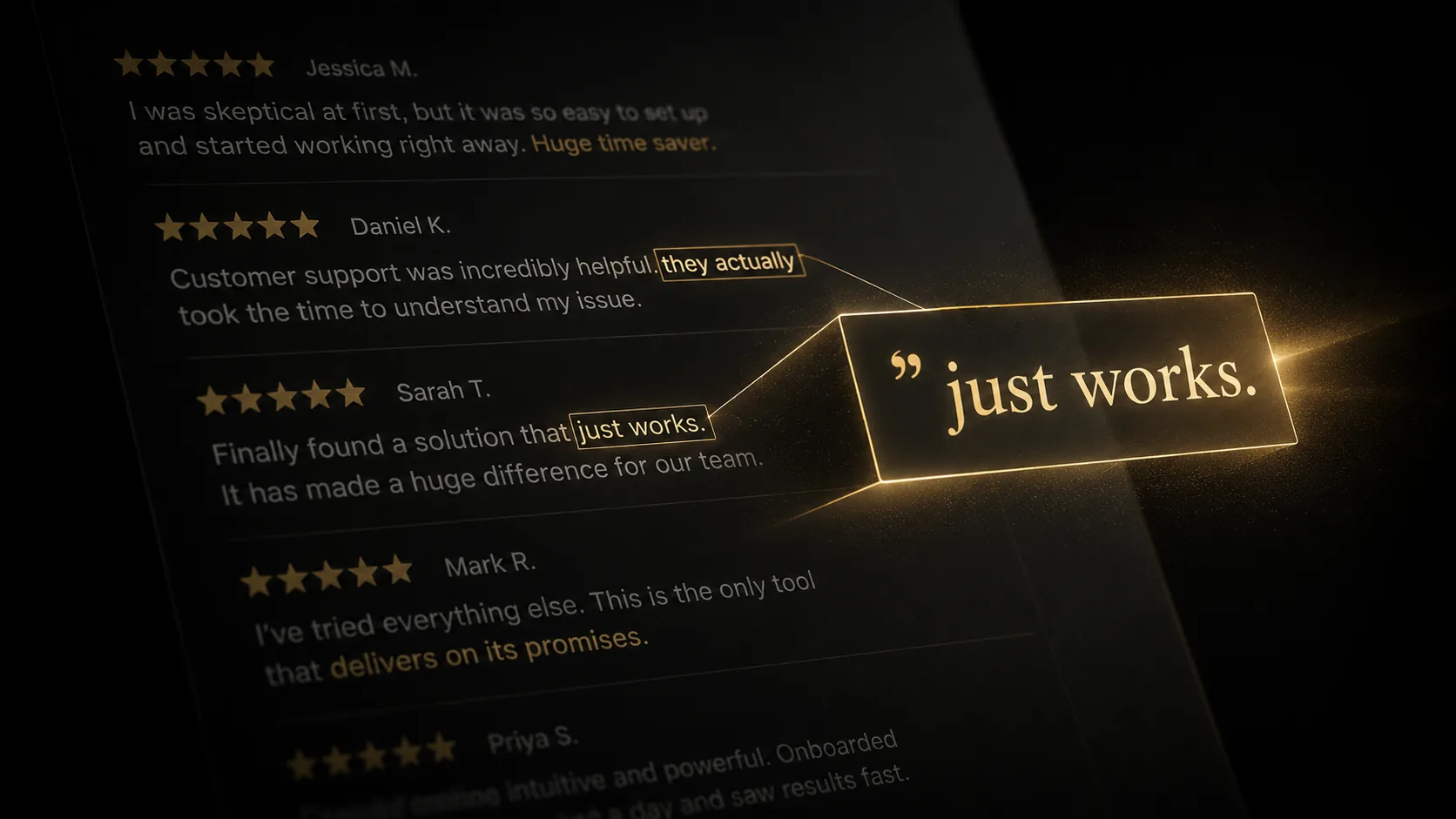
Every marketing guide says the same thing: "use the voice of your customer." Almost none of them say how, past "read your reviews." Which is true advice in the way "eat vegetables" is true advice — correct, and completely useless without a method attached.
So here's the method. It's not mine — it comes from Joanna Wiebe, who more or less invented the practice of "message mining" for conversion copywriting. But it's exactly what I use before writing anything, and it's more mechanical than most people expect.
Where the Words Actually Are
Your customers already wrote your best copy. It's just scattered across places nobody thinks to check as a single source:
- Product or service reviews — yours and your competitors'
- Support tickets and live chat transcripts
- Post-purchase survey responses
- Sales call recordings or transcripts
- Forum threads and comment sections where your category gets discussed
Most businesses have at least two of these sitting in a folder somewhere, unread since the day they were collected. That's not a criticism — it's just where the actual research usually goes to die.
The Method: Pull, Then Sort
Wiebe's approach, in practice, has two steps. First, pull everything from roughly the last 90 days — recent enough that it reflects how people talk about you now, not three years ago. Second, sort every sentence into one of a few buckets: objections (why someone almost didn't buy), outcomes (what actually changed for them), transformation language (the specific words they use for before/after), and confusion points (what they misunderstood before things clicked).
That sorting step is the part everyone skips. Reading fifty reviews and feeling "inspired" isn't research — it's vibes with extra steps. Sorting by category is what turns a pile of quotes into copy you can actually use.
Prioritize two buckets above the others: objection language and transformation language. Those two are consistently the highest-leverage phrases in the whole pile — the words that either almost stopped someone from buying, or the words they used the moment it worked.
Why This Beats Writing From Imagination
The gap between "copy I imagine my customer wants to hear" and "copy built from what they actually said" is bigger than it sounds. In one documented case, a headline rebuilt from customer language generated more than 400% more clicks on the main call-to-action button, and over 20% more form submissions than the original.
That's not because the new headline was cleverer. It's because it used a phrase the reader had already thought, in their own words, before they ever landed on the page. Robert Collier called this "entering the conversation already taking place in the customer's mind" — and reviews are one of the few places that conversation is written down verbatim, instead of guessed at.
What This Looks Like in an Afternoon
You don't need software or a research team for a first pass. Export whatever reviews, tickets, or survey responses you have. Read through once just to sort into the four buckets above. Then look for phrases that repeat — three different customers using a near-identical phrase is a much stronger signal than one customer's clever turn of phrase, however quotable it sounds.
The repeated, unremarkable phrase is usually more valuable than the eloquent one. It means that's how a real chunk of your market actually thinks, not how one especially articulate customer happened to phrase it that one time.
This is also, not coincidentally, most of what a real conversion audit is checking for underneath the surface — whether a page's language matches how the actual buyer already thinks, or whether it's describing the product the way the business sees it instead. The gap between those two is usually the whole story.